
A mat for each doorway
Four floors, four materials, and the sizes that fit each one. What belongs outside the front door, at the shower and in front of the sink.
- 3 minread at 200 words a minute
- 603 wordslength of this guide
- 2 tablescounted from this catalogue
- 48 sizespriced in this update
A house has four floors that need a layer, and they need different ones. This guide puts each material where it works and gives the sizes in the range for that spot.
Outside the front door: rubber
The mat outside the door is a scraper. It takes grit off a sole before the sole reaches the hall, and it has to do that in rain, in snow and in August sun.
The open rubber pattern drops grit through and lets water run off, so the mat does not turn into a wet sponge on a porch. A closed textile mat outside the door holds water against the boot instead.
Measure the door swing before the mat. A 17 x 30 in mat covers a standard single door. A double door or a wide entry wants 24 x 36 in or more, so that both feet land on the mat rather than one foot on and one off.
| Size | Fits | Price | Per square foot | This mat |
|---|---|---|---|---|
| 17 x 30 in | Single door | $21.99 | $6.21 | |
| 36 x 24 in | Double door or wide entry | $39.99 | $6.67 | |
| 24 x 36 in | Double door or wide entry | $95.98 | $16.00 | |
| 47 x 32 in | Double door or wide entry | $55.99 | $5.36 |
At the shower and the basin: chenille or waffle
Chenille is a pile of soft loops and takes a lot of water in one step. It belongs at a shower door or beside a tub, where a wet foot lands once and hard.
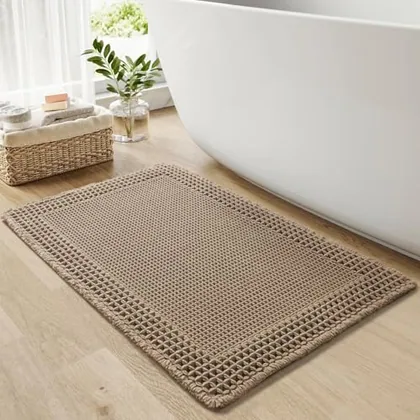
Waffle cotton is a woven grid. It holds less water at once and dries faster, which suits a basin, a family bathroom and any room where the mat is walked on all day rather than flooded twice.
Both fabrics sit on a rubber back that holds a dry tile, and both go in the machine. Neither one solves a bathroom with no ventilation.
| Size | Waffle cotton | Chenille | Colours | From this size |
|---|---|---|---|---|
| 17 x 24 in | $19.99 | not made | brown, green | |
| 17 x 27 in | not made | $19.99 | beige, brown, white | |
| 20 x 32 in | not made | $25.99 | grey, beige, white | |
| 24 x 36 in | $26.99 | $35.99 | brown, blue, white, grey, beige | |
| 24 x 48 in | $38.99 | not made | brown | |
| 24 x 71 in | not made | $55.99 | beige, brown | |
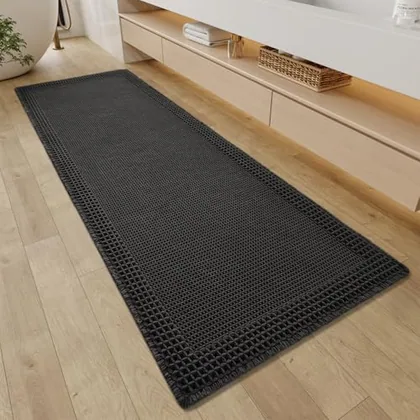
| 24 x 72 in | $45.99 | not made | black |
In front of the sink: a runner
The kitchen floor takes standing rather than splashing. A runner covers the strip between the sink and the stove, which is where a person spends an hour and where a spill lands.
Thin is the point here. The mat has to sit under a cabinet door and not trip anyone who turns quickly with a pan.
Two mats at one door
An entry that gets weather works best with two layers: a rubber scraper outside and an absorbent mat inside. The first takes the grit, the second takes the water that came in with the boot.
One mat doing both jobs is the compromise most halls live with. If that is the case, put the rubber mat outside and keep a towel by the door in winter.
Sun, rubber and light stone
Natural rubber can leave a shadow on pale stone in strong sun. It is not a stain in the paint sense, and it settles when a mat sits in one place for a season.
Move the mat when you sweep the porch. The mark does not form under a mat that shifts a few inches every week.
Washing each material
Waffle and chenille both go in the machine on a warm wash. Dry them flat or on a rail. High dryer heat is what ends the life of a rubber back, so keep them out of a hot cycle.
Rubber door mats do not go in a machine at all. Lift, shake, hose, and let the mat dry before it goes back down.
A double vanity, and other long spots
A basin with two taps needs a runner rather than a mat. The range goes to 24 x 71 in in chenille and 24 x 72 in in waffle, which covers a double vanity with room at both ends.
The same runner shape works along a bath in a narrow bathroom, where a square mat leaves half the wet floor uncovered.
Under a rug: felt
The layer under a rug is not a mat at all. It is a felt sheet, cut smaller than the rug, and its job is to stop the rug moving and to take the step for it.
Sizing that layer has its own rules, and they are in the other guide.
Sizing a rug padSee all Resare door matsSee all Resare bath mats