
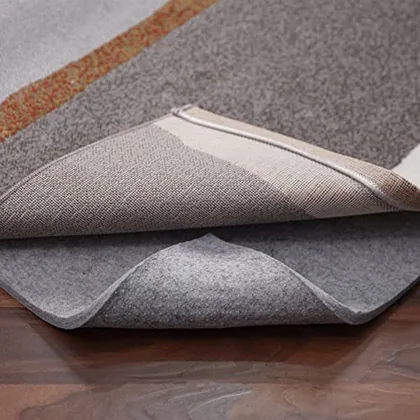
Sizing a rug pad
Measure the rug, take an inch off each side, and read the price per square foot before you compare two sizes.
- 4 minread at 200 words a minute
- 761 wordslength of this guide
- 1 tablecounted from this catalogue
- 48 sizespriced in this update
A rug pad is the one floor purchase where the number on the label is not the number you want. The pad goes under the rug, not next to it, so it has to be smaller. This guide gives the measurement, the two thicknesses, and a table of what each size in the range works out to per square foot.
Measure the rug, not the room
Lay a tape along the rug itself, edge to edge, and write both numbers down. Rugs are sold in round sizes and cut in real ones, so a rug sold as 5 x 7 often measures 5 ft by 6 ft 10 in.
Take one inch off each side of the measured rug. A 5 x 7 rug wants a pad about 4 ft 10 in by 6 ft 10 in. The pad then sits back from the fringe, which keeps a grey line from showing at the edge and keeps a toe from catching the pad.
The two thicknesses do different jobs
The 1/8 in pad is the low one. It fits under a door that swings over the rug, in front of a cabinet with a shallow toe kick, and under a rug on a stair landing. It holds the rug still and adds almost no height.
The 1/4 in pad is the cushion. It takes the step in a room with a hard floor, keeps the pile from grinding against itself, and adds enough weight that a light rug stops travelling. In a bedroom or a living room it is the one to take.
Find the pad for your rug
Put in the two sides of the rug. We name the pad size to take, what it costs in each thickness, and where to check the price.
What each size costs per square foot
Two pads at different prices are hard to compare until the area is in the picture. The last column below divides the price by the area, so a runner and a room-sized pad can be read against each other.
| Size | 1/8 in | 1/4 in | Dual surface | From, per square foot | From this size |
|---|---|---|---|---|---|
| 2 x 5 ft | not made | $24.69 | not made | $2.47 | |
| 2 x 6 ft | not made | not made | $18.99 | $1.58 | |
| 2 x 7 ft | not made | $23.79 | not made | $1.70 | |
| 3 x 5 ft | $25.99 | $22.99 | not made | $1.53 | |
| 2.6 x 6 ft | not made | not made | $20.99 | $1.35 | |
| 2 x 8 ft | $22.99 | $17.99 | $19.99 | $1.12 | |
| 2.6 x 8 ft | not made | $34.19 | $22.99 | $1.11 | |
| 3 x 8 ft | not made | $44.64 | not made | $1.86 | |
| 2.6 x 10 ft | $35.99 | $37.99 | not made | $1.38 | |
| 3 x 10 ft | not made | $47.49 | not made | $1.58 | |
| 2.6 x 12 ft | not made | $43.69 | not made | $1.40 | |
| 5 x 7 ft | $42.74 | not made | $29.99 | $0.86 | |
| 6 x 9 ft | not made | $56.79 | not made | $1.05 | |
| 7 x 9 ft | $37.99 | not made | not made | $0.60 | |
| 8 x 10 ft | $89.99 | $66.49 | not made | $0.83 | |
| 9 x 12 ft | not made | $99.99 | $89.99 | $0.83 |
The pattern in that column is the useful part. Small runners cost the most per square foot, and the price falls as the size grows. If a room takes a large pad, the large pad is the cheaper floor.
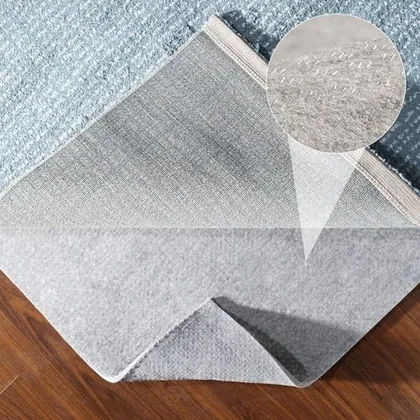
Cutting a pad down
Felt cuts straight with heavy scissors and does not fray, so a size close to yours can be trimmed. Lay the pad face down, put the rug on top of it, mark one inch inside the rug edge on all four sides, and cut.
Cut in one pass rather than sawing at the felt. A clean edge sits flat under wool; a chewed edge shows as a ridge.
Under a door, and other tight spots
Open the door before you choose a thickness. A door that clears the rug by a quarter inch will catch on a 1/4 in pad and will pass over a 1/8 in one.
The same test works at a cabinet, a low sofa foot and a radiator. Measure the gap, then take the pad that fits under it with room to spare.
A runner in a hallway
Hallways get the most travel in a house and the least attention when a pad is bought. A runner without a pad walks sideways until one end sits against the skirting board and the other end has turned.
The runner sizes in the range go from 2 x 5 up to 2.6 x 12 ft. Measure the runner, take the inch off each side, and take the next size down if you land between two. Trimming a pad is a five minute job; a pad that is too big shows at the edge for years.
What a pad does not fix
A rug that curls at the corner is a rug with a memory, not a rug without a pad. Roll it back the other way for a week and weight the corner while it settles.
A hollow floorboard still sounds hollow through felt. A pad softens a step and quietens a scuff, and it does nothing about the joist underneath.
Pads on carpet
A small rug on a low pile carpet does creep, and a pad slows it down. On a deep pile nothing holds: the rug floats on the pile and moves with it, whatever sits between them.
If the rug on carpet is there for looks rather than for warmth, a thinner pad is the better one. It keeps the rug from riding up at the edge where the two piles meet.
Care that keeps a floor happy
Sweep or vacuum the floor before the pad goes down, because grit under any pad is what marks a finish over time. Lift the rug and the pad twice a year, especially in a room that gets mopped, and let the floor dry before they go back.